How We Improve a Website's SEO Using Google Search Console Data
This is how we improve a website's search traffic: we read the site's own Google Search Console data, find where it is already being shown but not clicked, fix those pages, and measure again a few weeks later. Below is the process step by step, with the real numbers from The Pharma Partner, a pharmaceutical compliance consultancy whose site we run, including one fix that did not work.
The short version: SEO for most small and mid-sized sites is not about guessing keywords. Google already tells you, for free, every search your site appeared in, how often, at what position and how many people clicked. The work is reading that data properly, changing the right pages, and being honest about what moved.
- Get Search Console data and save a dated snapshot.
- Compare it with the previous snapshot.
- Group searches by what the searcher wants.
- Find the click leaks, near misses and competing pages.
- Fix a focused set of pages.
- Re-measure in four to six weeks, and drop what did not work.
Step 1: Get the data and keep a dated snapshot
Google Search Console is free. Once a site is verified, its Performance report shows clicks, impressions, click-through rate (CTR) and average position for every search and page. You can export it as a set of spreadsheets with one click, or pull it through the Search Console API.
We save every pull as a dated folder and never overwrite it. That sounds like housekeeping, but it is what makes the rest possible. Two caveats we keep in view:
- An export is capped, usually at 1,000 rows, so its totals are the top searches, not the whole site.
- Each export covers a rolling window (for example the last 90 days), so two exports taken on different days are compared for direction, not to the exact click.
Step 2: Compare it with the last snapshot
Looking at one report tells you where you are. Comparing two tells you what your changes did. We use a small script that takes two snapshot folders and prints the same sections every time: totals, where the audience is, searches grouped by intent, which pages gained or lost, click leaks, new searches worth noticing and searches that stopped bringing clicks.
We built it because the manual way failed us. One Pharma Partner snapshot from 15 August sat unexamined for six weeks, while a later round of changes quietly fixed two of its biggest findings. When a review takes one command, it gets done often enough to matter.
Here is how the site's Search Console totals moved across three exports:
| 90-day window ending | Clicks | Impressions |
|---|---|---|
| 8 June 2026 | 409 | 8,000 |
| 14 August 2026 | 4,627 | 147,702 |
| Late September 2026 | 7,070 | 310,000 |
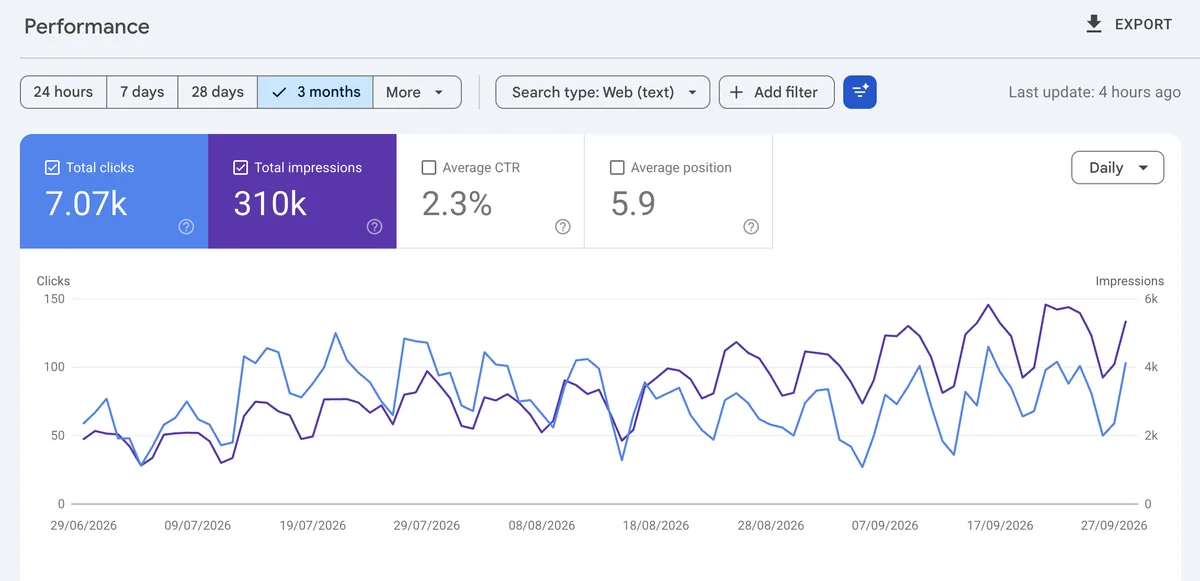
Those are big numbers, and the next step is about not being fooled by them.
Step 3: Group searches by what the searcher wants
A site can grow fast on traffic that will never buy anything. So we sort every search into groups that match the business. For The Pharma Partner, the groups were its free tools (expiry date, shelf life and mean kinetic temperature calculators, an SOP checker) and its paid services (Kenyan regulatory work, product registration, pharmacovigilance).
From the August export, this is where the clicks actually came from:
| Search group | Clicks | Impressions |
|---|---|---|
| Expiry and shelf-life tools | 2,378 | 68,224 |
| Mean kinetic temperature and cold chain | 443 | 8,459 |
| SOP and quality systems | 153 | 2,695 |
| Kenya regulatory | 2 | 724 |
| Registration and dossiers | 1 | 240 |
The free tools were doing their job of bringing people in, but the searches that lead to paid work earned almost nothing. Splitting by country made it sharper: more than half the clicks came from India, and only 4% from Kenya, the market that can actually hire a Kenyan regulatory consultant. That changed what we worked on next.
Step 4: Find the click leaks, near misses and competing pages
Three lists come out of every review.
Click leaks
Searches with a lot of impressions and a very low CTR. We flag anything with 400 or more impressions and under 1.5% CTR. The page is already being shown, so a better title, description or page should earn more clicks without any new ranking. In August the biggest was "shelf life calculator": 28,533 impressions at position 6.3, but only 0.69% CTR.
Near misses
Searches where the site sits between position 4 and 20. These are close enough to page one that a matching heading, a fuller answer or a few internal links can move them.
Competing pages
When several pages from the same site appear for one search, Google splits the signal between them. In October we found that "ppb ectd" and "ectd ppb" had about 650 impressions between them and roughly one click, because four of the site's own pages were competing:
| Page | Impressions | Avg position |
|---|---|---|
| /regulatory/dossiers | 397 | 6.75 |
| /regulatory/ctd-ectd-dossier-guide | 103 | 5.27 |
| /regulatory/dossier-preparation | 63 | 8.81 |
| /regulatory | 3 | 13.0 |
Step 5: Fix a focused set of pages
The fixes themselves are rarely exotic. In the 20 August round on The Pharma Partner we:
- Rewrote titles and descriptions so they lead with the exact search, for example putting "Shelf Life Calculator" first on the expiry calculator.
- Added depth where the page was thin: a definition-first section for "what is MKT", worked examples, and an IVD dossier section on the Uganda registration page, which had 1,434 impressions for that search and no clicks.
- Added FAQs and structured data (FAQPage and SoftwareApplication) so results can show richer snippets.
- Added internal links between related tools, guides and the matching service page.
Before that, at the end of July, the site gained 15 new free tools aimed at searches the data showed people were already making. By October several of them were earning clicks from a standing start.
For the competing dossier pages, we chose the guide as the one page for that search, put "PPB eCTD" at the front of its title, and repointed the link on the dossiers page that had been sending that phrase to a third page.
Step 6: Re-measure, and be honest about what did not work
We compare a new snapshot against the old one four to six weeks after a change. On 1 October the results were mixed, which is normal:
- Kenyan clicks doubled, from 199 to 409, and new tools earned clicks from a standing start.
- The shelf-life title rewrite did not work. "shelf life calculator" went from 28,533 impressions at 0.69% CTR to 50,483 at 0.58%.
Splitting that one search by device explained it. At the same average position of about 6, desktop CTR was 1.09% but mobile was 0.30%, and 65% of the impressions were on mobile, 78% of them from India. At position 6 on a phone, people rarely scroll that far. That is a ranking problem, not a title problem, and the audience is mostly people who will never buy a Kenyan registration. So we recommended spending no more effort on it, and moved the time to Kenyan searches.
The rule we work by: a change that does not move the number after a fair wait gets dropped, not repeated with different words. Saying so in the report is part of the job.
What this looks like for your site
Most business sites are smaller than The Pharma Partner, and the review is quicker, but the questions are the same. Which searches already show your site? Which of them are you losing the click on? Are two of your pages competing? Is the traffic from people who can actually buy from you? And did the last change work?
If your site is new, the first job is simpler: make sure Google can find and index it, submit a sitemap, and get your business onto Google Maps with a Business Profile. The data you need for everything above starts building from there.
We offer this as a service for any website, whether we built it or not: a one-off SEO Audit for KES 10,000, a Fix Sprint where we also make the changes and re-measure for KES 35,000, or ongoing SEO Growth at KES 20,000 a month. See our SEO services for what each includes, and Search Console results from more of the sites we work on.
Frequently asked questions
What is a click leak in Google Search Console?
A search where your page is shown often but rarely clicked: high impressions and a low click-through rate. The page already ranks, so improving the title, description or the page itself is often the cheapest traffic available.
What is keyword cannibalisation?
When several pages on the same site compete for one search. Google splits the signal between them, so none ranks as well as one clear page would. The fix is to pick one page for the search and point the others to it.
How often should Search Console be reviewed?
Every two to four weeks for a site that is actively being improved. Changes take two to six weeks to show, so reviewing more often mostly measures noise.